lbls = np.random.randint(0, 2, size=(10)) # Dataset of size 10 (train=8, valid=2)
is_valid = lambda i: i >= 8
dblock = DataBlock(blocks=[CategoryBlock],
getters=[lambda i: lbls[i]], splitter=FuncSplitter(is_valid))
dset = dblock.datasets(list(range(10)))
item_tfms = [ToTensor()]
wgts = range(8) # len(wgts) == 8
dls = dset.weighted_dataloaders(bs=1, wgts=wgts, after_item=item_tfms)Data Callbacks
Callbacks which work with a learner’s data
CollectDataCallback
def CollectDataCallback(
after_create:NoneType=None, before_fit:NoneType=None, before_epoch:NoneType=None, before_train:NoneType=None,
before_batch:NoneType=None, after_pred:NoneType=None, after_loss:NoneType=None, before_backward:NoneType=None,
after_cancel_backward:NoneType=None, after_backward:NoneType=None, before_step:NoneType=None,
after_cancel_step:NoneType=None, after_step:NoneType=None, after_cancel_batch:NoneType=None,
after_batch:NoneType=None, after_cancel_train:NoneType=None, after_train:NoneType=None,
before_validate:NoneType=None, after_cancel_validate:NoneType=None, after_validate:NoneType=None,
after_cancel_epoch:NoneType=None, after_epoch:NoneType=None, after_cancel_fit:NoneType=None,
after_fit:NoneType=None
):
Collect all batches, along with pred and loss, into self.data. Mainly for testing
WeightedDL
def WeightedDL(
dataset:NoneType=None, # Map- or iterable-style dataset from which to load the data
bs:NoneType=None, # Size of batch
wgts:NoneType=None, shuffle:bool=False, # Whether to shuffle data
num_workers:int=None, # Number of CPU cores to use in parallel (default: All available up to 16)
verbose:bool=False, # Whether to print verbose logs
do_setup:bool=True, # Whether to run `setup()` for batch transform(s)
pin_memory:bool=False, timeout:int=0, batch_size:NoneType=None, drop_last:bool=False, indexed:NoneType=None,
n:NoneType=None, device:NoneType=None, persistent_workers:bool=False, pin_memory_device:str='',
wif:NoneType=None, before_iter:NoneType=None, after_item:NoneType=None, before_batch:NoneType=None,
after_batch:NoneType=None, after_iter:NoneType=None, create_batches:NoneType=None, create_item:NoneType=None,
create_batch:NoneType=None, retain:NoneType=None, get_idxs:NoneType=None, sample:NoneType=None,
shuffle_fn:NoneType=None, do_batch:NoneType=None
):
Weighted dataloader where wgts is used for the training set only
Datasets.weighted_dataloaders
def weighted_dataloaders(
wgts, bs:int=64, shuffle_train:bool=None, # (Deprecated, use `shuffle`) Shuffle training [`DataLoader`](https://docs.fast.ai/data.load.html#dataloader)
shuffle:bool=True, # Shuffle training [`DataLoader`](https://docs.fast.ai/data.load.html#dataloader)
val_shuffle:bool=False, # Shuffle validation [`DataLoader`](https://docs.fast.ai/data.load.html#dataloader)
n:int=None, # Size of [`Datasets`](https://docs.fast.ai/data.core.html#datasets) used to create [`DataLoader`](https://docs.fast.ai/data.load.html#dataloader)
path:str | Path='.', # Path to put in [`DataLoaders`](https://docs.fast.ai/data.core.html#dataloaders)
dl_type:TfmdDL=None, # Type of [`DataLoader`](https://docs.fast.ai/data.load.html#dataloader)
dl_kwargs:list=None, # List of kwargs to pass to individual [`DataLoader`](https://docs.fast.ai/data.load.html#dataloader)s
device:torch.device=None, # Device to put [`DataLoaders`](https://docs.fast.ai/data.core.html#dataloaders)
drop_last:bool=None, # Drop last incomplete batch, defaults to `shuffle`
val_bs:int=None, # Validation batch size, defaults to `bs`
):
Create a weighted dataloader WeightedDL with wgts for the training set
dls.show_batch() # if len(wgts) != 8, this will fail"1
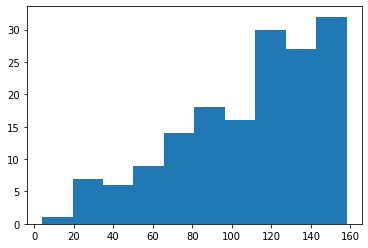
n = 160
dsets = Datasets(torch.arange(n).float())
dls = dsets.weighted_dataloaders(wgts=range(n), bs=16)
learn = synth_learner(data=dls, cbs=CollectDataCallback)learn.fit(1)
t = concat(*learn.collect_data.data.itemgot(0,0))
plt.hist(t.numpy());[0, nan, None, '00:00']

DataBlock.weighted_dataloaders
def weighted_dataloaders(
source, wgts, bs:int=64, verbose:bool=False,
shuffle_train:bool=None, # (Deprecated, use `shuffle`) Shuffle training [`DataLoader`](https://docs.fast.ai/data.load.html#dataloader)
shuffle:bool=True, # Shuffle training [`DataLoader`](https://docs.fast.ai/data.load.html#dataloader)
val_shuffle:bool=False, # Shuffle validation [`DataLoader`](https://docs.fast.ai/data.load.html#dataloader)
n:int=None, # Size of [`Datasets`](https://docs.fast.ai/data.core.html#datasets) used to create [`DataLoader`](https://docs.fast.ai/data.load.html#dataloader)
path:str | Path='.', # Path to put in [`DataLoaders`](https://docs.fast.ai/data.core.html#dataloaders)
dl_type:TfmdDL=None, # Type of [`DataLoader`](https://docs.fast.ai/data.load.html#dataloader)
dl_kwargs:list=None, # List of kwargs to pass to individual [`DataLoader`](https://docs.fast.ai/data.load.html#dataloader)s
device:torch.device=None, # Device to put [`DataLoaders`](https://docs.fast.ai/data.core.html#dataloaders)
drop_last:bool=None, # Drop last incomplete batch, defaults to `shuffle`
val_bs:int=None, # Validation batch size, defaults to `bs`
):
Create a weighted dataloader WeightedDL with wgts for the dataset
dls = dblock.weighted_dataloaders(list(range(10)), wgts, bs=1)
dls.show_batch()0
PartialDL
def PartialDL(
dataset:NoneType=None, # Map- or iterable-style dataset from which to load the data
bs:NoneType=None, # Size of batch
partial_n:NoneType=None, shuffle:bool=False, # Whether to shuffle data
num_workers:int=None, # Number of CPU cores to use in parallel (default: All available up to 16)
verbose:bool=False, # Whether to print verbose logs
do_setup:bool=True, # Whether to run `setup()` for batch transform(s)
pin_memory:bool=False, timeout:int=0, batch_size:NoneType=None, drop_last:bool=False, indexed:NoneType=None,
n:NoneType=None, device:NoneType=None, persistent_workers:bool=False, pin_memory_device:str='',
wif:NoneType=None, before_iter:NoneType=None, after_item:NoneType=None, before_batch:NoneType=None,
after_batch:NoneType=None, after_iter:NoneType=None, create_batches:NoneType=None, create_item:NoneType=None,
create_batch:NoneType=None, retain:NoneType=None, get_idxs:NoneType=None, sample:NoneType=None,
shuffle_fn:NoneType=None, do_batch:NoneType=None
):
Select randomly partial quantity of data at each epoch
FilteredBase.partial_dataloaders
def partial_dataloaders(
partial_n, bs:int=64, shuffle_train:bool=None, # (Deprecated, use `shuffle`) Shuffle training [`DataLoader`](https://docs.fast.ai/data.load.html#dataloader)
shuffle:bool=True, # Shuffle training [`DataLoader`](https://docs.fast.ai/data.load.html#dataloader)
val_shuffle:bool=False, # Shuffle validation [`DataLoader`](https://docs.fast.ai/data.load.html#dataloader)
n:int=None, # Size of [`Datasets`](https://docs.fast.ai/data.core.html#datasets) used to create [`DataLoader`](https://docs.fast.ai/data.load.html#dataloader)
path:str | Path='.', # Path to put in [`DataLoaders`](https://docs.fast.ai/data.core.html#dataloaders)
dl_type:TfmdDL=None, # Type of [`DataLoader`](https://docs.fast.ai/data.load.html#dataloader)
dl_kwargs:list=None, # List of kwargs to pass to individual [`DataLoader`](https://docs.fast.ai/data.load.html#dataloader)s
device:torch.device=None, # Device to put [`DataLoaders`](https://docs.fast.ai/data.core.html#dataloaders)
drop_last:bool=None, # Drop last incomplete batch, defaults to `shuffle`
val_bs:int=None, # Validation batch size, defaults to `bs`
):
Create a partial dataloader PartialDL for the training set
dls = dsets.partial_dataloaders(partial_n=32, bs=16)assert len(dls[0])==2
for batch in dls[0]:
assert len(batch[0])==16